We have compiled a list of manufacturers, distributors, product information, reference prices, and rankings for Atmosphere Heating Furnace.
ipros is IPROS GMS IPROS One of the largest technical database sites in Japan that collects information on.

Atmosphere Heating Furnace - List of Manufacturers, Suppliers, Companies and Products | IPROS GMS

Atmosphere Heating Furnace Product List

1~5 item / All 5 items

Displayed results

Semi-automatic vertical atmosphere heating furnace LAM type

User-friendly and multipurpose, general-purpose semi-automatic tempering furnace.

This is a vertical atmosphere furnace for quenching molds and jigs. By introducing nitrogen gas into the furnace, simple non-oxidizing heat treatment can be performed. There are two types: one for air-cooled steel and one for oil-cooled steel. In the case of air-cooled steel, it consists of a heating furnace and a front platform, while for oil-cooled steel, it is composed of a heating furnace and an oil tank. *The front platform for air-cooled steel is optional. With its simple structure and easy operation, it is an ideal device for in-house production and switching from atmospheric heat treatment!

  • Other machine tools
  • Electric furnace
  • Other cutting tools
  • Atmosphere Heating Furnace

Added to bookmarks

Bookmarks list

Bookmark has been removed

Bookmarks list

You can't add any more bookmarks

By registering as a member, you can increase the number of bookmarks you can save and organize them with labels.

Free membership registration

Multi-atmosphere furnace |Precision design with dual axes of atmosphere and temperature

Vacuum replacement → Program switch to air/N2/Ar/(small amount of H2 as needed). Reproduce and evaluate phase transition, phase stability, and surface chemistry well.

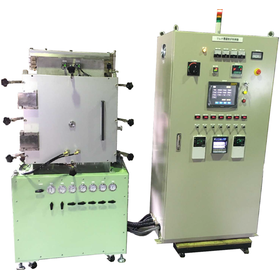
Our company offers a "Multi-Atmosphere Furnace" that is precisely designed for material evaluation and phase transition testing in oxidation/reduction atmospheres, utilizing a dual-axis of "atmosphere x temperature." It features a built-in vacuum system that allows for vacuum replacement before and after processing, followed by replacement with the specified gas, thereby reducing the risk of residual gas during furnace opening. Additionally, the high degree of freedom in tray design allows for parallel DOE (Design of Experiments) under the same conditions and multiple samples, enabling the extraction of optimal conditions for scale-up in a short cycle. [Reasons why our carbon furnace is effective for graphitization] - Compatible with generated gases such as NH3 and CO: Designed with materials, piping temperature control, and instrumentation tailored to gas characteristics. - Built-in vacuum system: Allows for vacuum replacement before and after processing, followed by replacement with the specified gas, reducing the risk of residual gas during furnace opening. - Rectangular casing x stacked design: High flexibility in tray design allows for parallel DOE under the same conditions and multiple samples, enabling the extraction of optimal conditions for scale-up in a short cycle. *For more detailed information, please download the materials or feel free to contact us.

  • Industrial Furnace
  • Atmosphere Heating Furnace

Added to bookmarks

Bookmarks list

Bookmark has been removed

Bookmarks list

You can't add any more bookmarks

By registering as a member, you can increase the number of bookmarks you can save and organize them with labels.

Free membership registration

Multi-Atmosphere Furnace | Dew Point Control and Metal Surface Treatment with Humid Atmosphere

Manage dew point and oxygen concentration to prevent oxidation, modify, and pre-treat metal surfaces.

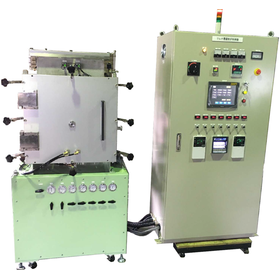
In the surface treatment of metal parts and powder materials, not only temperature but also ambient gas, dew point, oxygen concentration, and treatment time significantly affect the surface condition and quality. In particular, for oxidation prevention, surface modification, coating pretreatment, and hydrophilization/hydrophobicity treatment, it is important to reproducibly examine conditions while switching between dry, humid, and reducing atmospheres. Our multi-atmosphere furnace can switch between various ambient gases such as N2, Ar, Air, H2, and NH3 after displacing the air in the furnace through vacuum replacement. Additionally, by connecting a Wetter, it is possible to manage surface treatment conditions with controlled humid atmospheres and dew points. 【Features】 ■ Capable of switching to various gas atmospheres after vacuum replacement ■ Supports humid atmosphere and dew point control through Wetter connection ■ Can manage atmosphere history such as dry → humid → dry ■ Applicable for oxidation prevention, surface modification, and pretreatment of metal surfaces ■ Condition management combining dew point meters and O2 meters can also be considered *For more details, please download the materials or contact us.

  • Industrial Furnace
  • Atmosphere Heating Furnace

Added to bookmarks

Bookmarks list

Bookmark has been removed

Bookmarks list

You can't add any more bookmarks

By registering as a member, you can increase the number of bookmarks you can save and organize them with labels.

Free membership registration

Selection of furnace for Cl₂・HCl special atmosphere sintering | Corresponding to chlorination reaction and corrosion evaluation

Organize the firing conditions and safety specifications using corrosive gases.

Are you considering sintering, chlorination reactions, and corrosion evaluation in a special atmosphere such as Cl₂ and HCl? In sintering using corrosive and reactive gases like Cl₂ and HCl, it is necessary to consider specifications not only for temperature and gas concentration but also for materials inside the furnace, jig materials, sealing materials, piping, valves, exhaust piping, pollution control devices, and safety interlocks. In particular, for chlorination reactions and volatile separation, the volatility of the generated chlorides, condensation location, recovery methods, insulation of exhaust piping, and pollution control capabilities are important. Additionally, since corrosive gases are handled, leak prevention measures, gas detection, exhaust routes, and safety shutdown conditions significantly impact equipment specifications. This document organizes the treatment objectives, gas conditions, furnace type selection, and key points for confirming jigs, piping, exhaust, pollution control, and safety measures in Cl₂ and HCl special atmosphere sintering. - For sintering and reaction evaluation in Cl₂ and HCl atmospheres - For consideration of chlorination reactions, volatile separation, and impurity removal - For removal of deposits from jigs and components, and evaluation of corrosion and durability - For insulation of exhaust, condensation measures, and specification review of pollution control devices - For sintering tests and condition exploration before equipment installation

  • Industrial Furnace
  • Atmosphere Heating Furnace

Added to bookmarks

Bookmarks list

Bookmark has been removed

Bookmarks list

You can't add any more bookmarks

By registering as a member, you can increase the number of bookmarks you can save and organize them with labels.

Free membership registration

Multi-atmosphere furnace | For chemical reactions, reactive gas treatment, and exhaust gas evaluation

Support for examining the conditions of chemical reaction processes, including reactive gases and exhaust gas treatment.

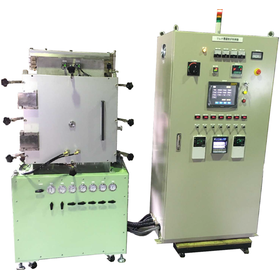
In the development of chemical reaction processes, the reaction efficiency and safety can vary significantly due to factors such as temperature, ambient gases, and the exhaust gas components generated during the reaction. Particularly in reactions involving gases like NH3 and CO, as well as in the examination of reaction conditions under multiple atmospheres such as Air, N2, Ar, vacuum, and ammonia, it is crucial to design not only the furnace itself but also the gas supply, exhaust, and emission control systems. Our multi-atmosphere furnace can be custom-designed to match the material inside the furnace, gas supply lines, exhaust systems, emission control equipment, and safety measures according to the treated materials and reaction gases. We can accommodate everything from research and development to prototype and pre-mass production evaluations for chemical reactions, thermal decomposition, reduction reactions, oxidation reactions, and ammonia atmosphere treatments. ■ I want to examine the reaction conditions for chemical reaction processes. ■ I want to consider exhaust equipment assuming the generation of gases like NH3 and CO. ■ I want to process under multiple atmospheres such as Air, N2, Ar, vacuum, and ammonia. ■ I want to examine the internal material and sealing structure of the furnace according to the reaction gas. ■ The existing furnaces do not match the gas types, exhaust specifications, and safety measures. * The materials include the basic configuration of the multi-atmosphere furnace, compatible atmospheres, gas supply and exhaust systems, and design points when handling reactive gases.

  • Industrial Furnace
  • Atmosphere Heating Furnace

Added to bookmarks

Bookmarks list

Bookmark has been removed

Bookmarks list

You can't add any more bookmarks

By registering as a member, you can increase the number of bookmarks you can save and organize them with labels.

Free membership registration